




- Subjects >
- Science >
- Reception >
- Reception units >
EYFS outcomes
Development matters
- Explore the natural world around them.
- Describe what they see, hear and feel whilst outside.
- Recognise some environments that are different to the one in which they live.
See Development Matters (non-statutory curriculum guidance) – contains public sector information licensed under the Open Government Licence v3.0.
Early learning goals
ELG: Understanding the world – The natural world
- Explore the natural world around them, making observations and drawing pictures of animals and plants.
- Know some similarities and differences between the natural world around them and contrasting environments, drawing on their experiences and what has been read in class.
See Statutory framework for the early years foundation stage.
Teacher video: Animal adventures

Lessons
Lesson 1: Living and non-living

Lesson 2: Describing minibeasts
Lesson 3: On the farm
Lesson 4: Animal homes
Lesson 5: Zoo animals
Key skills
- With support,

This content is for subscribers only. Join for access today.
Key knowledge
To know:
-
This content is for subscribers only. Join for access today.
Key vocabulary
alive
compare
This content is for subscribers only. Join for access today.
Continuous provision
Equipment list
Equipment needed across all lessons in this unit.
This list does not include equipment which is usually readily available in the classroom (e.g pencils, A4 paper etc)
 Download
Full equipment list for the subject
Quantities marked × will update. Items without quantities are unaffected
-
PE hoops
×8 - Objects for sorting living and non-living things (e.g. a potted plant, an insect in a lidded box, a seed, a water bottle, etc) ×8
- Device for taking photographs ×8
-
Lidded box with breathing holes to collect minibeasts
×1 - ‘What the ladybird heard’ storybook by Julia Donaldson ×1
-
Small world farm animals
-
Building equipment for making animal pens (e.g. wooden blocks, plastic blocks or magnetic tiles).
- ‘Dear zoo’ storybook by Rod Campbell ×1
-
Eight small world animals to represent the animals in the ‘Dear zoo’ storybook
This content is for subscribers only. Join for access today.
Related content
Unit resources

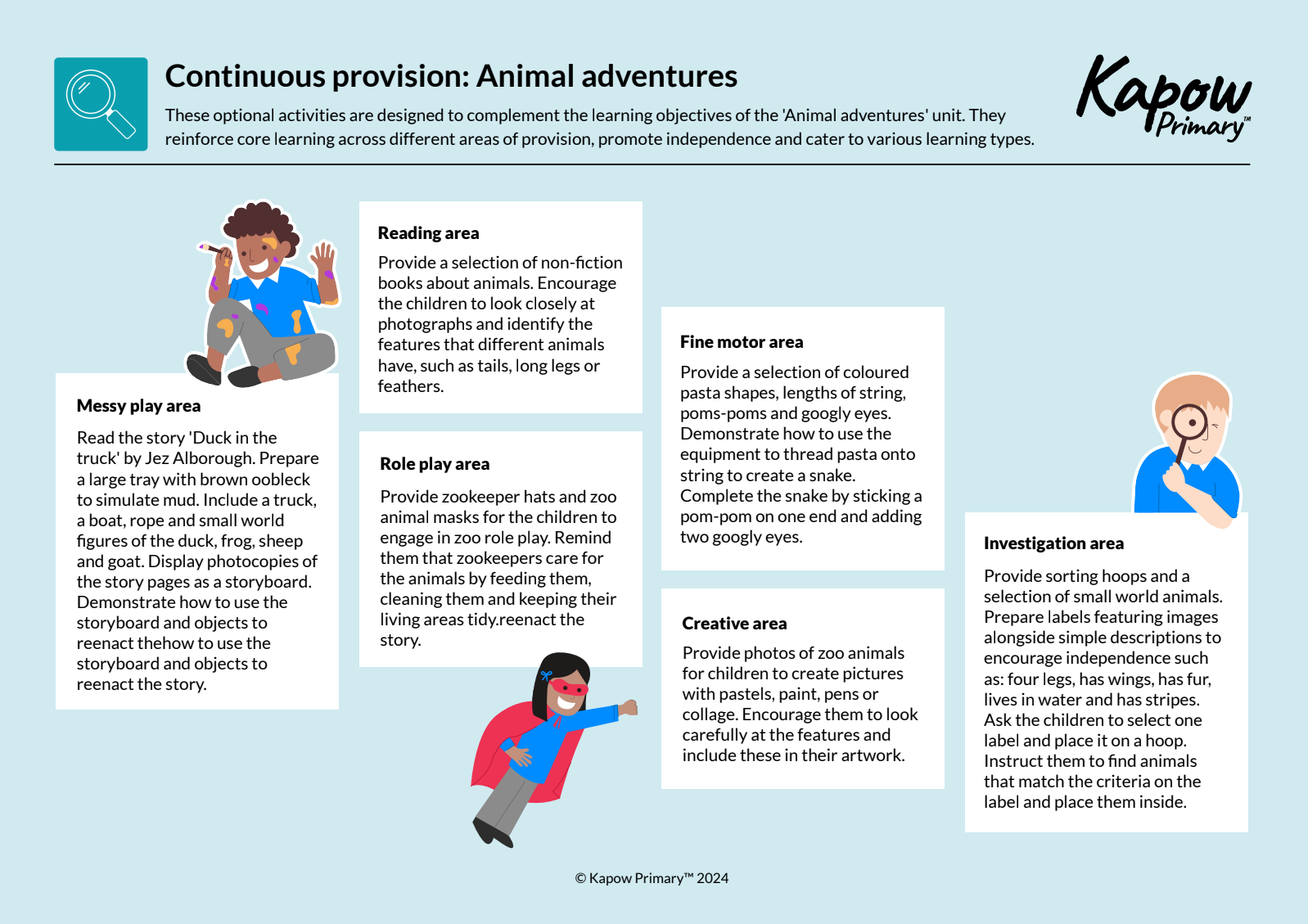
Continuous provision ideas – Science EYFS: Animal adventures
Continuous provision activities to complement the EYFS unit 'Animal Adventures'.
Subject resources
This content is for subscribers only. Join for access today.
