


Y5/6 (A): Animals, including humans: Circulation and health
Exploring the heart and circulatory system through models and enquiries and considering how lifestyle choices affect our health.
Unit outcomes
Pupils who are secure will be able to:
- Recall factors that improve someone’s health and those that impact health negatively and suggest improvements to someone’s health.
- Describe the circulatory system as the heart and blood vessels transporting blood around the body and recall that the heart is a pump that pushes blood through the circulatory system.
- Describe the pathway of blood through the circulatory system, including passing through the heart twice in a complete circuit through the body.
- Describe some of the functions of blood, including transporting substances like oxygen, water and nutrients around the body.
- Recall what is meant by heart rate and research using multiple websites to find reliable animal masses.
- Identify the pattern between animals’ size and heart rate and quote values as evidence.
- Describe how different exercises affect heart rate and explain why heart rate changes during exercise.
- Describe what happens to heart rate during and after exercise and compare two sets of heart data to identify a link between heart rate and fitness.
When working scientifically, pupils who are secure will be able to:
- Evaluate the trustworthiness of secondary sources that provide health advice.
- Evaluate the model blood by considering a strength and a weakness when representing blood and suggesting improvements.
- Compare class values and recognise when they do not match.
- Use identified patterns to predict new values.
- Write a method for an enquiry with consideration of equipment, the different versions of the changed variable and how to complete the measured variable.
- Choose a suitable title and axis labels with units for the line graph and plot points on the line graph.
Suggested prior learning
Y3/4 (A): Animals, including humans: Digestion and food
Get started
Lessons
Y5/6 (A): Lesson 1: Factors affecting health
Y5/6 (A): Lesson 2: The heart and circulatory system
Y5/6 (A): Lesson 3: Blood
Y5/6 (A): Lesson 4: Heart rate
Y5/6 (A): Lesson 5: Investigating exercise and heart rate
Y5/6 (A): Lesson 6: Heart rate and fitness
Key skills
Planning
- Suggesting which variables will

This content is for subscribers only. Join for access today.
Key knowledge
To know:
- The main parts
This content is for subscribers only. Join for access today.
Key vocabulary
anomaly
blood
This content is for subscribers only. Join for access today.
Equipment list
Equipment needed across all lessons in this unit.
This list does not include equipment which is usually readily available in the classroom (e.g pencils, A4 paper etc)
 Download
Full equipment list for the subject
Quantities marked × will update. Items without quantities are unaffected
- Modelling the circulatory system (2 large red hoops; 2 large blue hoops; 1 large hoop of another colour; chalk for drawing on the ground; 5 bowls or containers; at least 30 red beanbags, balls or pieces of card; at least 30 blue beanbags, balls or pieces of card; at least 20 beanbags, balls or pieces of card in green and yellow). ×1
- Modelling blood (small, transparent bottle or tube with a lid; cooking oil to fill container halfway; red liquid food colouring; white mini marshmallows or beads; small chopped up pieces of light-coloured paper; teaspoons of sugar and salt; some water; mixture of small beads or cake sprinkles). ×1
- Sticky notes
-
Devices for internet research
×15 - Sticky tack
- Pulsometers, data loggers or smart watches for measuring heart rate ×15
- Stopwatches ×8
- Rulers ×30
The equipment below is optional
- Lab coat and stethoscope ×1
- Dice and counters ×15
- Calculators ×8
-
Graph paper
×30
This content is for subscribers only. Join for access today.
Related content
Unit resources


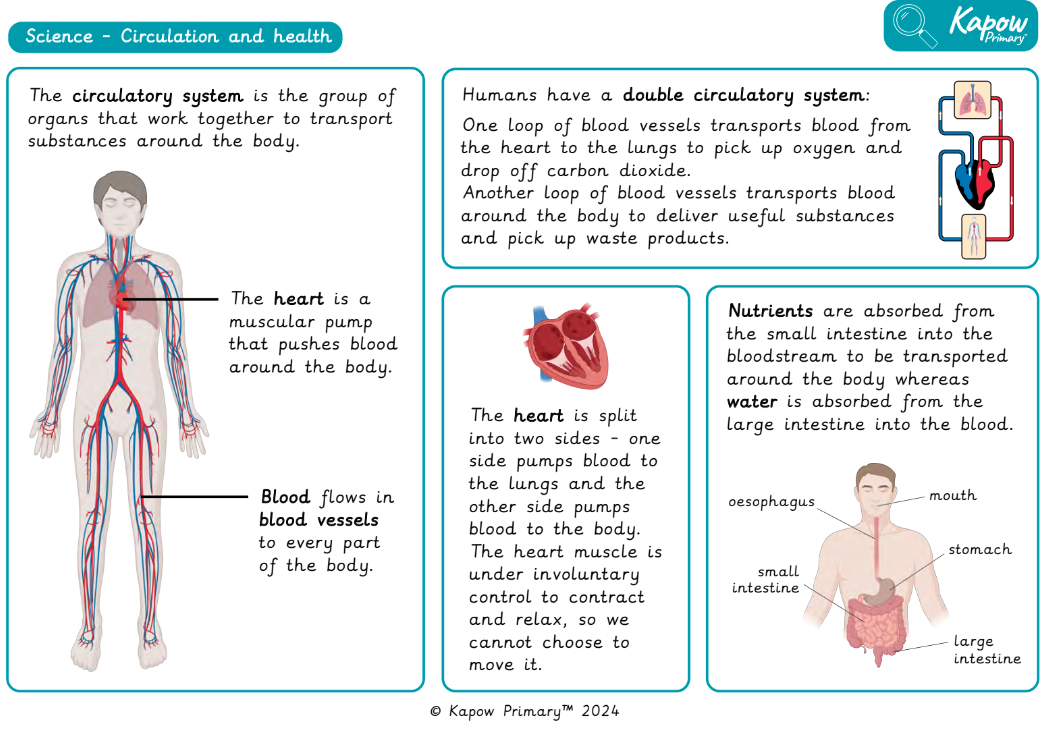
Knowledge organiser – Science Y5/6 (A): Animals, including humans: Circulation and health
Aimed at pupils, three page which gives key facts and definitions from the mixed-age 'Circulation and health' unit.
Vocabulary display – Science Y5/6 (A): Animals, including humans: Circulation and health
A display version of the key vocabulary from the mixed-age unit 'Circulation and health'.
Subject resources
This content is for subscribers only. Join for access today.
Cross-curricular opportunities
English: Spoken language; Writing – composition; Reading.
Mathematics: Number – number and place value; Measurement; Statistics.
Design technology: Cooking and nutrition.
RSE: Mental wellbeing; Physical health and fitness; Healthy eating; Drugs, alcohol and tobacco; Health and prevention.
Physical education.
British values: Rule of law; Mutual respect.
