




- Subjects >
- Science >
- Reception >
- Reception units >
Across the year
These six standalone lessons should be taught at the end of each half-term. The timing is flexible but they should be planned to coincide with typical seasonal changes.
EYFS outcomes
Development matters
- Explore the natural world around them.
- Describe what they see, hear and feel whilst outside.
- Understand the effect of changing seasons on the natural world around them.
See Development Matters (non-statutory curriculum guidance) – contains public sector information licensed under the Open Government Licence v3.0.
Early learning goals
ELG: Understanding the world – The natural world
- Explore the natural world around them, making observations and drawing pictures of animals and plants.
- Understand some important processes and changes in the natural world around them, including the seasons and changing states of matter.
See Statutory framework for the early years foundation stage.
Teacher video: Changing seasons

Lessons
Lesson 1: Autumn treasures


Lesson 2: Whatever the weather
Lesson 3: Winter wildlife
Lesson 4: Springtime magic
Lesson 5: Sandcastle science
Lesson 6: Summer senses
Key skills
- Beginning to

This content is for subscribers only. Join for access today.
Key knowledge
To know:
-
This content is for subscribers only. Join for access today.
Key vocabulary
autumn
season
This content is for subscribers only. Join for access today.
Continuous provision
Equipment list
Equipment needed across all lessons in this unit.
This list does not include equipment which is usually readily available in the classroom (e.g pencils, A4 paper etc)
 Download
Full equipment list for the subject
Quantities marked × will update. Items without quantities are unaffected
Lesson 1: Autumn treasures
-
Carrier bags or bags for life for collecting autumn objects.
×15 -
Access to a variety of autumn objects like twigs, leaves and conkers
×1 -
Long strips of paper for leaf rubbings
×30 -
A selection of leaves for leaf rubbings
×1 -
Brown, yellow, red and orange crayons
×15
Lesson 3: Winter wildlife
- Paper plates ×30
- Modelling dough ×30
-
Twigs and sticks
×30 -
Peppercorns or sunflower seeds
×30
Lesson 4: Springtime magic
-
Bluetooth music system to use outside (optional).
×1 - Device for taking photographs ×8
Lesson 5: Sandcastle science
- Large sand tray ×1
-
At least 20 kg dry sand
×1 -
Plastic/paper cups
×30 -
A range of media for colouring flowers, e.g. oil pastels, chalk pastels, coloured pencils and felt tip pens.
Lesson 6: Summer senses
-
Large plastic tray filled with sand and seashells
×1 -
Large plastic tray filled with cold water and seaweed
×1 - Chalk ×30
-
Blindfolds (optional)
×8
This content is for subscribers only. Join for access today.
Related content
Unit resources

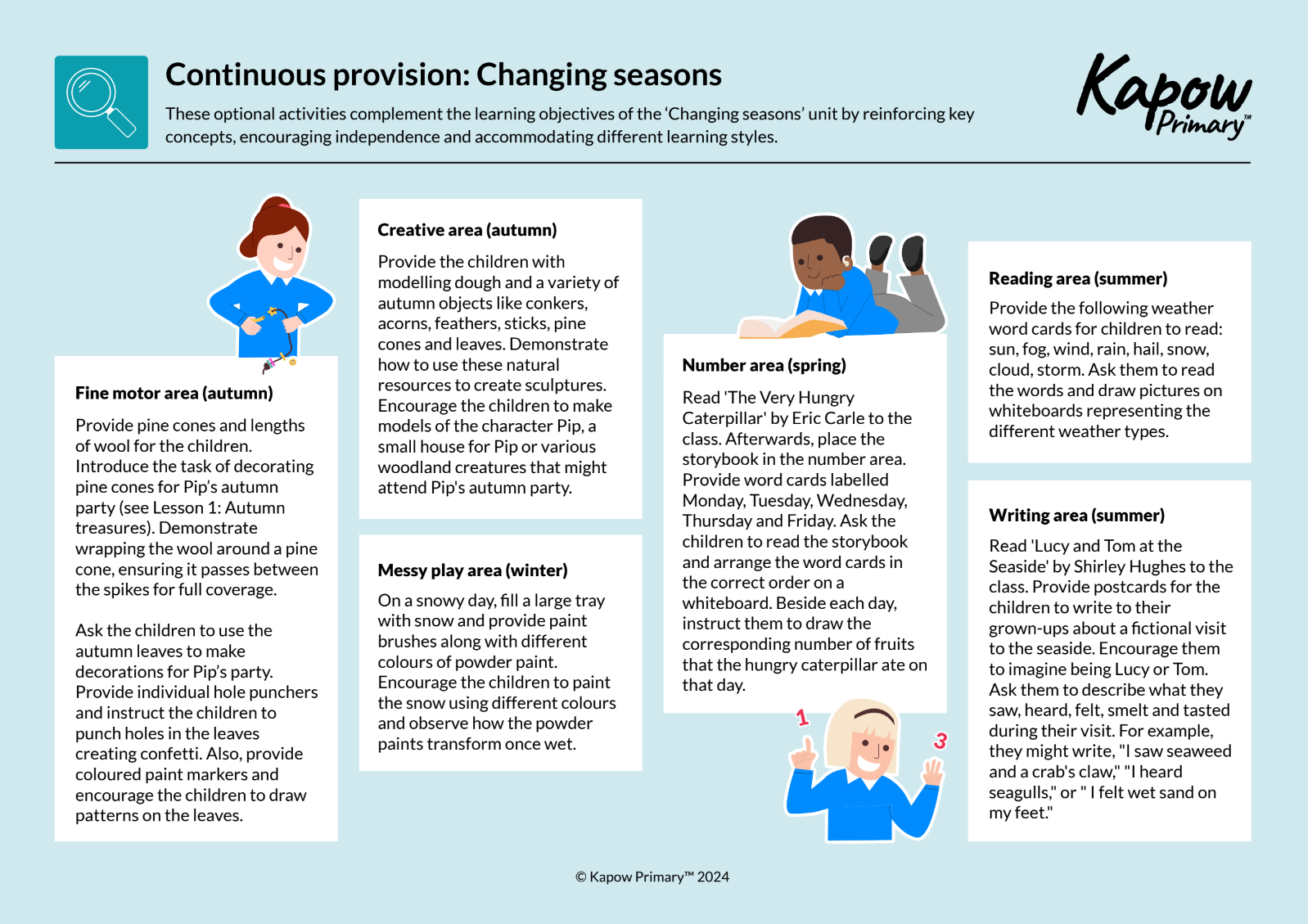
Continuous provision ideas – Science EYFS: Changing seasons
Continuous provision activities to complement the EYFS unit 'Changing seasons'.
Subject resources
This content is for subscribers only. Join for access today.
